Key takeaways
- 01A CUI campaign strips insulation once and files a report; a CUI program ranks susceptibility, inspects on a schedule, repairs, recoats and reassesses the frequency, so the second cycle is cheaper than the first.
- 02API 583 places carbon steel CUI susceptibility broadly between minus 12 and 175 degrees Celsius (10 to 350 degrees Fahrenheit), with cyclic and intermittent service the worst case, and austenitic stainless steel chloride cracking between about 60 and 205 degrees Celsius.
- 03Screening NDE (pulsed eddy current, profile radiography, guided wave) finds where to strip; it does not replace insulation removal and direct examination at the worst locations.
- 04Every CUI finding should end as a damage mechanism record with a repair, a recoat and a new inspection interval, not as a photograph in a report.
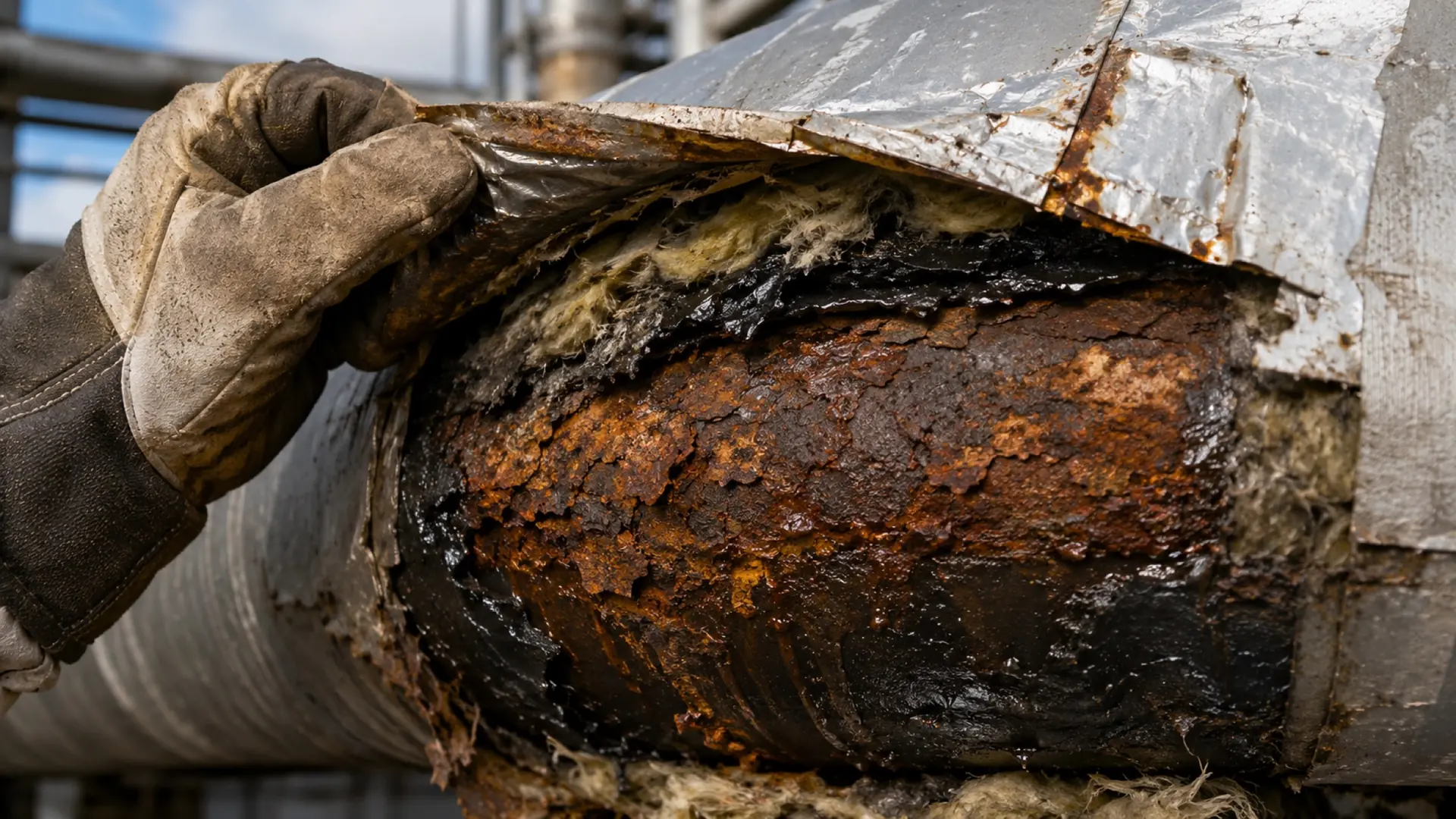
Most plants have run a CUI campaign. A leak or a near miss triggers a budget, contractors strip several kilometers of insulation, inspectors find what everyone expected to find, repairs are made, and a thick report is filed. Three years later the same conversation starts again, because the campaign answered "where is it corroding now" and not "how do we keep knowing." API 583, Corrosion Under Insulation and Fireproofing, is written as a program: susceptibility, prioritization, inspection, mitigation and reassessment as a cycle. API 570 tells you where on piping to look. This paper sets out the difference between a campaign and a program and what the program's records must carry to make the second cycle cheaper than the first.
What makes equipment susceptible to corrosion under insulation?
CUI requires three things: a metal surface, water reaching it, and a temperature that keeps the water active. Insulation supplies the trap; jacketing failures, penetrations and capillary action supply the water; the process supplies the temperature.
API 583 describes the susceptible range for carbon and low alloy steel as broadly minus 12 to 175 degrees Celsius (10 to 350 degrees Fahrenheit). Below that, water is frozen or the surface is too cold to wet. Above it, the surface dries. Within the range, rates climb toward the middle, and the worst cases are equipment that cycles through it (a line that is hot in operation and ambient during outages) or operates intermittently, because wet-dry cycling concentrates contaminants. Austenitic stainless steel is susceptible to external chloride stress corrosion cracking under insulation, most likely between about 60 and 205 degrees Celsius, and the source of chlorides is often the insulation itself or coastal and cooling tower air.
Other factors raise or lower susceptibility:
- Insulation type and whether it absorbs and holds water.
- Jacketing design and condition, including sealant age and orientation of seams.
- Coating under the insulation: none, a shop primer, or a coating system qualified for CUI service.
- Environment: marine, cooling tower drift, deluge test zones, steam leaks.
- Design details that hold water: horizontal runs with low points, vessel skirts, saddles, stiffening rings.
- Age of the insulation system and time since the last inspection.
A susceptibility ranking combines these into a priority per circuit or equipment item. It is the first record in the program and the one most sites skip.
Where does API 570 tell you to look on piping?
API 570 includes CUI as a specific inspection consideration and lists the locations most likely to show damage. The list is worth reproducing because it becomes the inspection plan:
- Penetrations and breaches in the insulation jacketing: nozzles, instrument connections, pipe hangers, and anything that pierces the weather barrier.
- Insulation terminations at flanges, valves and where insulated piping ends.
- Damaged or missing jacketing, and jacketing with failed or missing sealant at seams.
- Low points and dead legs where water collects, including the bottom of vertical runs.
- Steam tracing tubing penetrations.
- Pipe supports and shoes, especially bolted-on shoes that create crevices.
- Valves and fittings with irregular insulation surfaces that are hard to seal.
- Lifting lugs, nameplates and other attachments that interrupt the jacketing.
- Locations exposed to deluge or wash-down, or downwind of cooling towers.
- Piping that has been in service in the susceptible range for a long period, and piping with vibration that opens seams.
For vessels, API 510 and API 583 add skirts, saddles, stiffening rings, manway insulation, and the top of vertical vessels where jacketing ages fastest. The inspection plan lists these per item, so the inspector in the field is checking a list rather than walking a line hoping to notice something.
Which inspection methods find CUI, and what are their limits?
CUI inspection runs from cheapest and least certain to most expensive and most certain. A program uses the cheap methods to decide where to spend the expensive ones.
- External visual of the jacketing. Staining, rust bleed, bulging, missing sealant, damaged jacketing, and water ingress points. Fast, informative, and the trigger for everything else.
- Wet insulation detection. Neutron backscatter and infrared thermography locate wet insulation through the jacketing, indicating where water has entered.
- Screening NDE through insulation. Pulsed eddy current gives an average wall thickness under insulation and jacketing without removal, good for finding general thinning. Profile radiography (including real-time radiography) shows wall loss at the pipe profile, especially at low points and supports. Guided wave ultrasonics screens long runs from a single collar for gross metal loss. None of these resolves isolated pitting reliably, and each has thickness, geometry and jacketing limits.
- Insulation removal and direct examination. Windows or full stripping, then visual, surface cleaning, ultrasonic thickness and pit depth gauging. This is the confirmation step, and it is the only one that also tells you the condition of the coating.
The distinction that keeps a program honest is that screening finds where to strip; it does not certify a wall. A pulsed eddy current average within tolerance can sit over a single deep pit. Screening results should be recorded as screening results, with the method's limits, and the confirmed thickness at the stripped location is what enters the CML record and the remaining life calculation.
How should CUI findings turn into repairs and recoat?
A finding is a location with confirmed metal loss. What happens next is where campaigns stop and programs continue.
- Measure and assess. Remaining thickness against tMin for the design code; pit depth and extent; a fitness-for-service screening (API 579-1 Part 4 Level 1 for general metal loss) where the wall is below the corrosion allowance but above tMin. The result determines run, repair or replace.
- Repair. Weld repair, replacement spool, or an engineered composite repair with its own inspection interval. The repair record carries the procedure, the welder or installer qualification, and the post-repair inspection.
- Surface preparation and recoat. CUI is a coating failure as much as a corrosion problem. The recoat uses a coating system qualified for the service temperature range under insulation (immersion-grade epoxies, thermal spray aluminum, or inorganic systems depending on temperature), applied to a measured profile and dry film thickness, with the same hold points as any coating job.
- Reinstate insulation with attention to the cause: sealed jacketing seams oriented to shed water, drainage at low points, standoffs at supports, and inspection ports where the program will want to look again.
- Record the damage mechanism. CUI is a damage mechanism, and the finding should become a damage mechanism record on the equipment, not only a note in an inspection report, so the next planner sees it.
The recoat record deserves emphasis. If the profile, ambient conditions and DFT are not recorded, the next CUI cycle cannot distinguish a coating that failed from a coating that was never right.
How do you reassess frequency so the program runs itself?
The closing step of the API 583 cycle is reassessment. Every inspection produces evidence that changes the susceptibility ranking:
- Circuits stripped and found clean under intact coating move down the priority list and their interval lengthens.
- Circuits with confirmed CUI, repaired and recoated, get a shorter first interval to confirm the fix, then lengthen if clean.
- Circuits where screening found wet insulation but no metal loss get a jacketing repair and a short-interval visual.
- A process change that moves an item into or out of the susceptible temperature range re-ranks it immediately.
The frequency for CUI inspection is not fixed by API 570; it is part of the inspection plan set by the inspector and engineer, informed by the risk ranking and by API 570's class-based external inspection intervals. Programs that run well keep the ranking as a living record per circuit, with the evidence that justified each change. Programs that stall keep the ranking in a spreadsheet from the last campaign.
The economics follow. The first cycle strips a lot of insulation to build the evidence base. The second cycle strips where the evidence points. The third cycle mostly confirms.
How intelliSPEC handles it
intelliSPEC ships a CUI wizard family that follows the API 583 cycle: visual inspection, suspect area marking, insulation removal, UT after removal, advanced NDE, repairs, recoat, inspection test plans and frequency assessment. Each step writes to the same asset record, so the recoat and the thickness reading sit with the finding that caused them. Damage mechanisms (thinning, cracking) are first-class records on the equipment, not free text in a report.
Confirmed thickness enters the CML record, which carries nominal thickness, tMin and its method, corrosion allowance, latest thickness and three corrosion rates. intelliINTEGRITY computes tMin routed by equipment type to ASME B31.3, ASME Section VIII Division 1 or API 653, returns the design code and formula with the number, and runs API 579-1 Part 4 Level 1 screening (RSF as the ratio of measured thickness to tMin). Results are provisional until an engineer verifies them. The recoat step in intelliPAINT accepts DFT readings from gauges such as the DeFelsko PosiTector 6000 without retyping and carries DFT statistics and exception reports.
Field capture in intelliINSPECT works fully offline with no time limit on the local store, with photo and video bound to the location at capture time, and a GPS picker for locating findings on long runs. Completed records pin the form configuration they were executed with. For pipeline and terminal programs where CUI dominates the external corrosion budget, see pipelines and terminals.