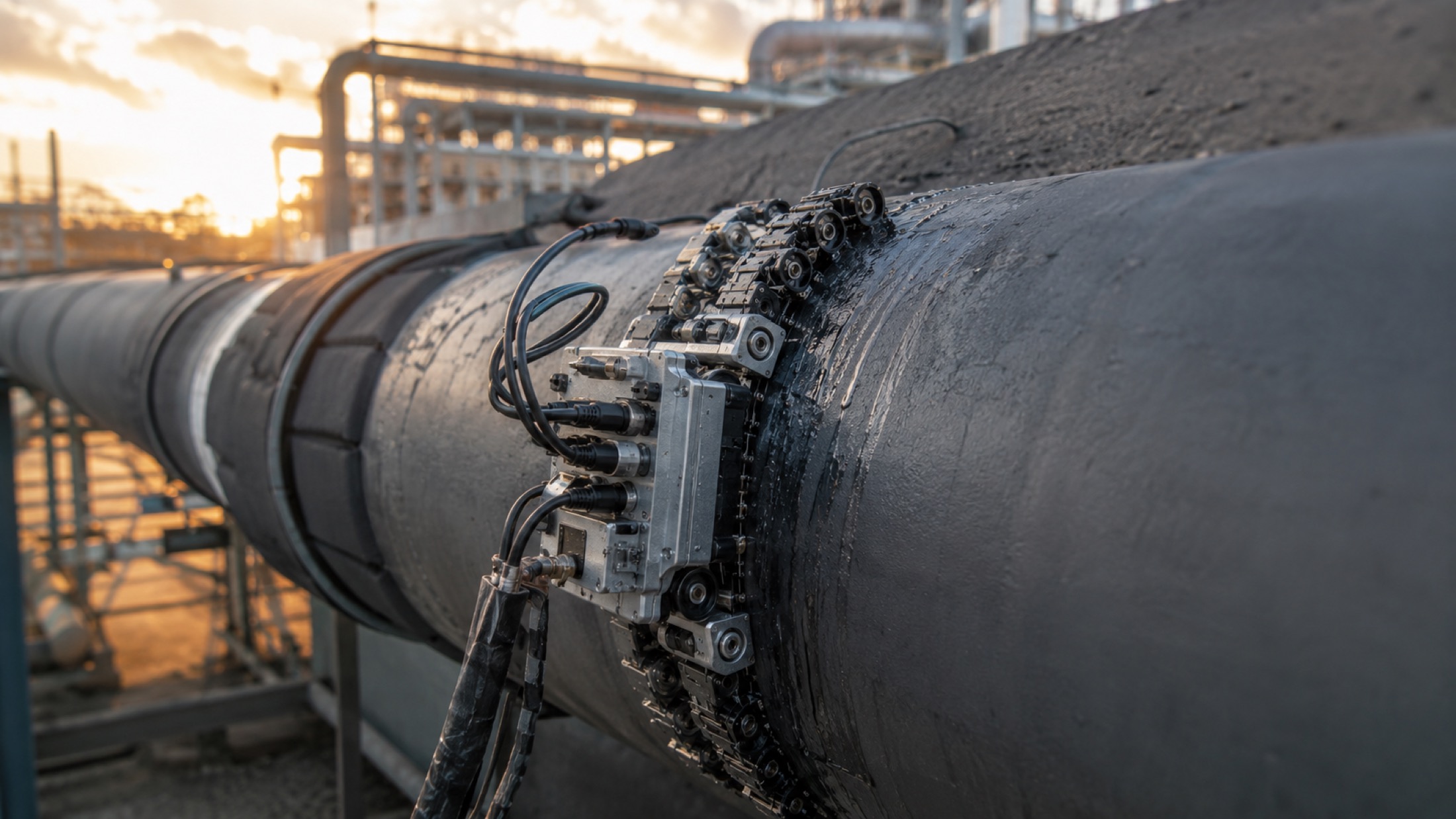
Radiographic testing
Radiography exposure time calculator
Start from one exposure on your own technique chart, then change the thickness, the source-to-film distance and the source activity. The calculator scales the exposure by half-value layers and the inverse square law and converts it to minutes and seconds.
Thickness factor
2.033x
Distance factor
1.653x
Required exposure
1008Ci·min
Exposure time
16:48min:sec
Advisory result. Provisional until a qualified inspector or engineer verifies it against the governing code edition.
How it works
- 01Thickness factor: 2 raised to (new thickness minus reference thickness) over the half-value layer for the isotope in steel.
- 02Distance factor: (new SFD / reference SFD) squared, the inverse square law.
- 03Required exposure in curie-minutes = reference x thickness factor x distance factor.
- 04Time = exposure / source activity in curies, shown as minutes and seconds.
Formulas
E = Eref x 2^((T - Tref)/HVL) x (SFD/SFDref)²t = E / A(Ci)Read before you rely on it
- Half-value layers are typical values for steel (Ir-192 about 12.7 mm, Co-60 about 21.6 mm, Se-75 about 8 mm); use your own if your chart differs.
- The reference exposure carries the film, screens, density and processing; the calculator only scales it.
- Source decay changes activity daily; enter today's activity from the decay chart.
Answers
Questions about this calculator
How do I calculate exposure time for Ir-192?
Take a known exposure from your technique chart, scale it for the new thickness using two to the power of the thickness change in half-value layers, scale for distance by the inverse square law, then divide by the source activity in curies to get minutes.
What is the half-value layer?
The thickness of material that halves the radiation intensity. Each additional half-value layer of steel doubles the exposure needed. For Ir-192 in steel it is about 12.7 mm; for Co-60 about 21.6 mm.
Why does distance matter so much?
Intensity falls with the square of distance. Moving the source from 700 mm to 900 mm raises the exposure by about 65 percent.
Does intelliSPEC hold RT technique data?
intelliNDT records the technique, the film or detector, source and exposure data with the radiograph interpretation, so the shot is reproducible and the reader can see the setup.