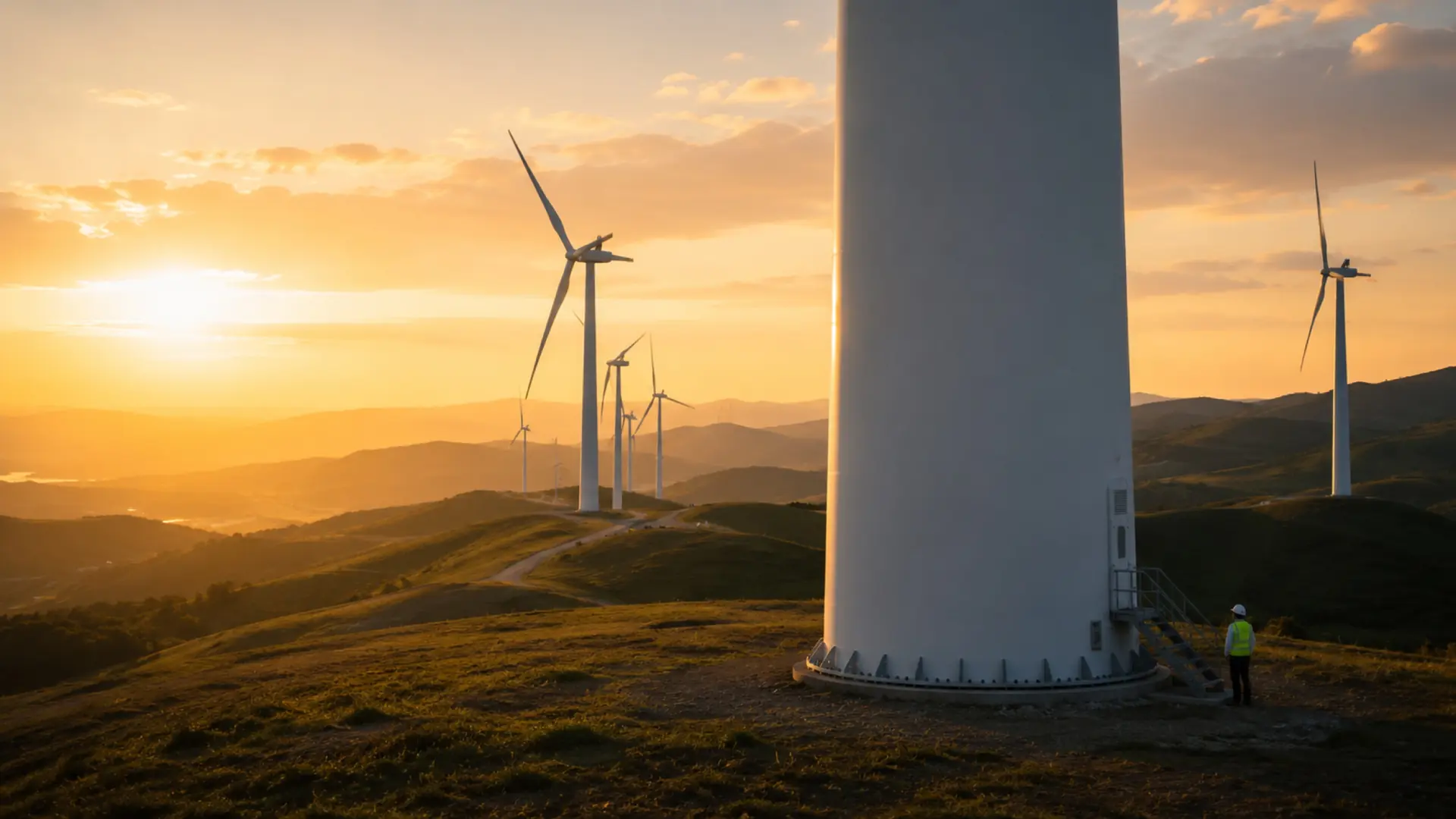
A renewable-energy operator managing hundreds of wind turbines and utility-scale solar collector substations across rural sites faced a familiar fleet problem: assets are identical on paper, miles apart in the field, and often outside cellular coverage.
Preparing end-of-warranty (EOW) claims against OEMs required proving exactly when leading-edge erosion, lightning-receptor damage, tower flange bolt-torque loss, or foundation grouting cracks appeared on each serialized blade and tower section.
Current state before intelliSPEC
- Drone and rope-access data in silos: Drone blade photos, rope-access repair reports, and ultrasonic/magnetic-particle tower weld inspections sat on separate contractor portals with inconsistent blade and radial-station naming.
- Unverified technician GWO credentials: Confirming Global Wind Organisation (GWO), high-voltage NFPA 70E, and ISO 9712 NDE certifications before crews climbed remote turbines required manual spreadsheet checks.
- Weak warranty packages: OEMs challenged warranty claims when defect progression could not be traced cleanly by serial number and radial meter mark across annual inspections.
Configured path
The operator implemented intelliVISION, intelliEDGE, intelliINSPECT, intelliNDT, intelliCREW, and intelliCOMPLY.
- Serial-level turbine and substation twin: Every turbine, nacelle component, blade serial, tower section, and main power transformer was registered in
. - Offline capture up-tower: Technicians carried
into nacelles and remote collector yards with zero signal, logging IEC 61400-23 blade defect grades (Categories 1 to 5), bolt-tensioning records, and transformer oil/thermal checks. - Qualification gating and OEM claim export:
verified GWO and NDE credentials at dispatch, andcompiled serial-specific defect timelines for OEM warranty submission.
Measured outcome
- Defensible OEM warranty recovery: Every end-of-warranty claim exports as a single package showing dated photos, radial position, severity progression, and technician signatures.
- Fleet-wide blade defect heatmaps: Reliability engineers filter Category 4 and 5 blade defects across all wind farms to bundle crane and rope-access repair campaigns.
- Zero uncertified climbs: GWO and electrical safety expiries are enforced before work orders are released.