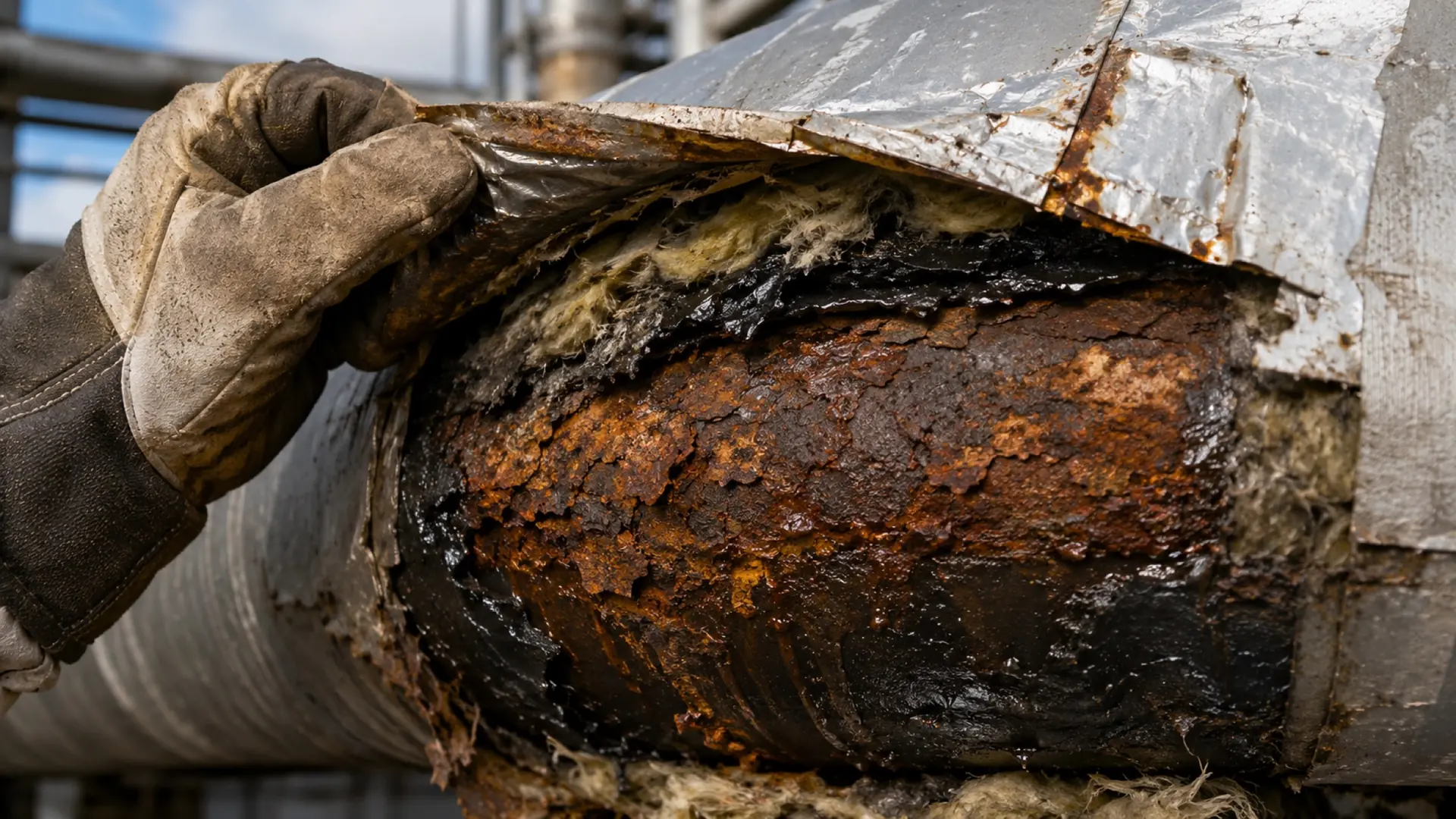
Corrosion under insulation (CUI) on carbon steel and external chloride stress corrosion cracking (ECSCC) on austenitic stainless steel between 10 F and 350 F (-12 C to 175 C) account for a disproportionate share of process piping leaks. Yet many sites still run CUI programs from spreadsheets that track how many linear feet of insulation were stripped rather than where water is actually entering and whether the coating barrier was restored properly.
Current state before intelliSPEC
- Low-yield calendar stripping: Scaffold and insulation crews stripped thousands of feet of clean pipe while missing wet, damaged jacketing on deadlegs, vertical risers, and insulation-support rings.
- Orphaned NDE screening data: Real-time radiography (RTR), pulsed eddy current (PEC), and neutron backscatter moisture surveys lived in vendor slide decks rather than on the piping circuit and CML register.
- Unclosed insulation windows: Inspection ports cut into jacketing were sometimes re-insulated before the bare steel was properly blasted and coated, accelerating future CUI at the exact spot inspected.
Configured path
The refinery deployed intelliVISION, intelliEDGE, intelliINSPECT, intelliNDT, intelliINTEGRITY, intelliPAINT, and intelliPROJECTS.
- API 583 susceptibility register: Operating temperature bands, insulation type (calcium silicate, mineral wool, cellular glass), coating age, and weather exposure were mapped per circuit in
and scored in. - Offline CUI visual and screening walks: Inspectors used
to log jacketing punctures, missing caulking, low-point drains, and PEC/RTR anomalies directly against the isometric location. - Mandatory recoating hold point before re-insulation: When insulation was stripped for UT wall verification in
,enforced surface prep and DFT sign-off before the re-insulation work package could close in.
Measured outcome
- Higher CUI hit rate per scaffold dollar: Stripping scope targets verified moisture traps and NDE screening anomalies rather than arbitrary percentage quotas.
- No bare steel re-covered: Every opened CUI window carries a signed coating record before jacketing is reinstalled.
- Live circuit remaining life: External CUI wall-loss rates feed the same API 570 piping record as internal corrosion readings.