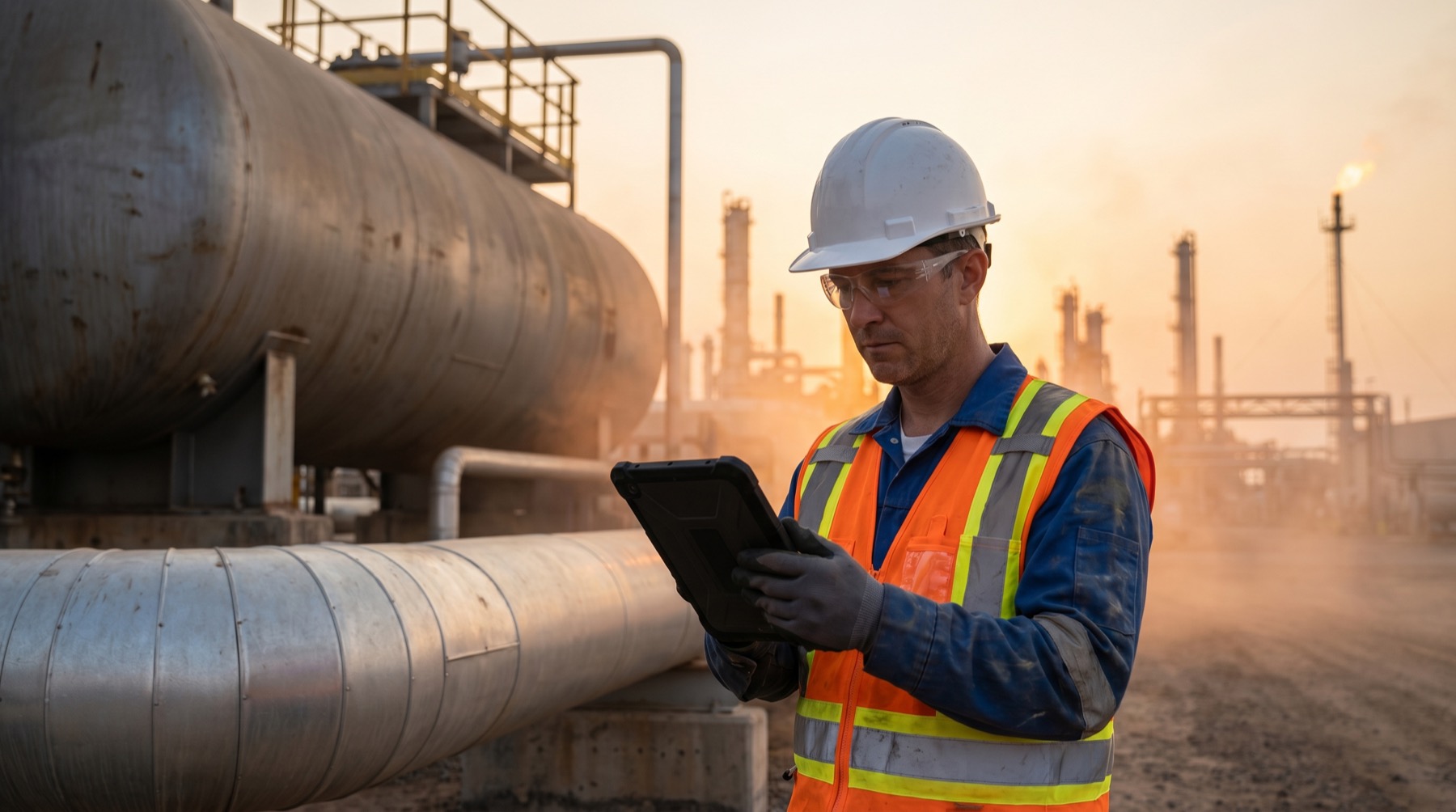
The places inspection work happens are, almost by definition, the places connectivity does not. Vessel internals behave like Faraday cages. Tank farms and pipe racks are steel canyons. Remote pipeline right-of-ways and offshore platforms are beyond coverage entirely, and many process units restrict or prohibit transmitting devices anyway. If a field application needs a network connection to accept a thickness reading, it has been designed for the office where it was demoed, not the confined space where it will be used.
What connectivity assumptions cost
The failure is rarely a crash. It is quieter and more expensive than that.
- Reversion to paper. The first time an app spins and loses an entry at the top of a scaffold, the crew goes back to the notebook, and the digital record becomes a transcription done at the trailer. Every benefit of structured capture, validation at entry, photo attachment at the location, timestamps that mean something, evaporates at the moment of transcription.
- Lost work. An app that holds data in memory until it can sync will eventually lose a morning's readings to a dead battery or a forced restart. Crews learn this once and never trust the tool again.
- Falsified timestamps. If records upload hours after capture and the system stamps them at upload, the record now says the inspection happened in the parking lot at 4 pm. For evidence that may face an auditor, that is not cosmetic.
What offline-first actually means
Offline-first is an architecture, not a feature toggle. The test is simple: the device must be the primary store, and the network must be an optimization.
- Everything needed for the job rides on the device. The equipment list, the form definitions, the prior history, checklists, and drawings are provisioned before the crew leaves coverage. A blank form without the CML history is half a tool.
- Capture commits locally, immediately. Readings, photos, voice notes, and signatures persist to device storage at the moment of entry, timestamped at capture. A battery pull five seconds later loses nothing.
- Sync is background and boring. When connectivity returns, at the gate, at the trailer, on the drive out, records reconcile without ceremony and without the technician managing it.
- Conflicts are handled, not ignored. Two technicians touching the same equipment offline is normal on a turnaround. The system has to merge deterministically and preserve both contributions rather than silently overwriting one.
The audit angle
There is a records-quality argument buried in the architecture. Data captured at the point of work, on the device, at the timestamp of the actual measurement, is stronger evidence than anything reconstructed later. The offline-first design is what makes capture-time recording physically possible in the environments where inspection happens. An app that only works connected guarantees that some fraction of your records are trailer reconstructions, and no one can say afterward which fraction.
When evaluating field software, skip the feature grid and run the field test: airplane mode, full shift, one battery swap, then sync. Where the data ends up, and what its timestamps say, tells you everything.
intelliSPEC was built offline-first because its users work in vessels, on right-of-ways, and behind blast walls. The record assembles on the device as the work happens and reconciles when the signal returns. Bring your worst dead zone to a demo.