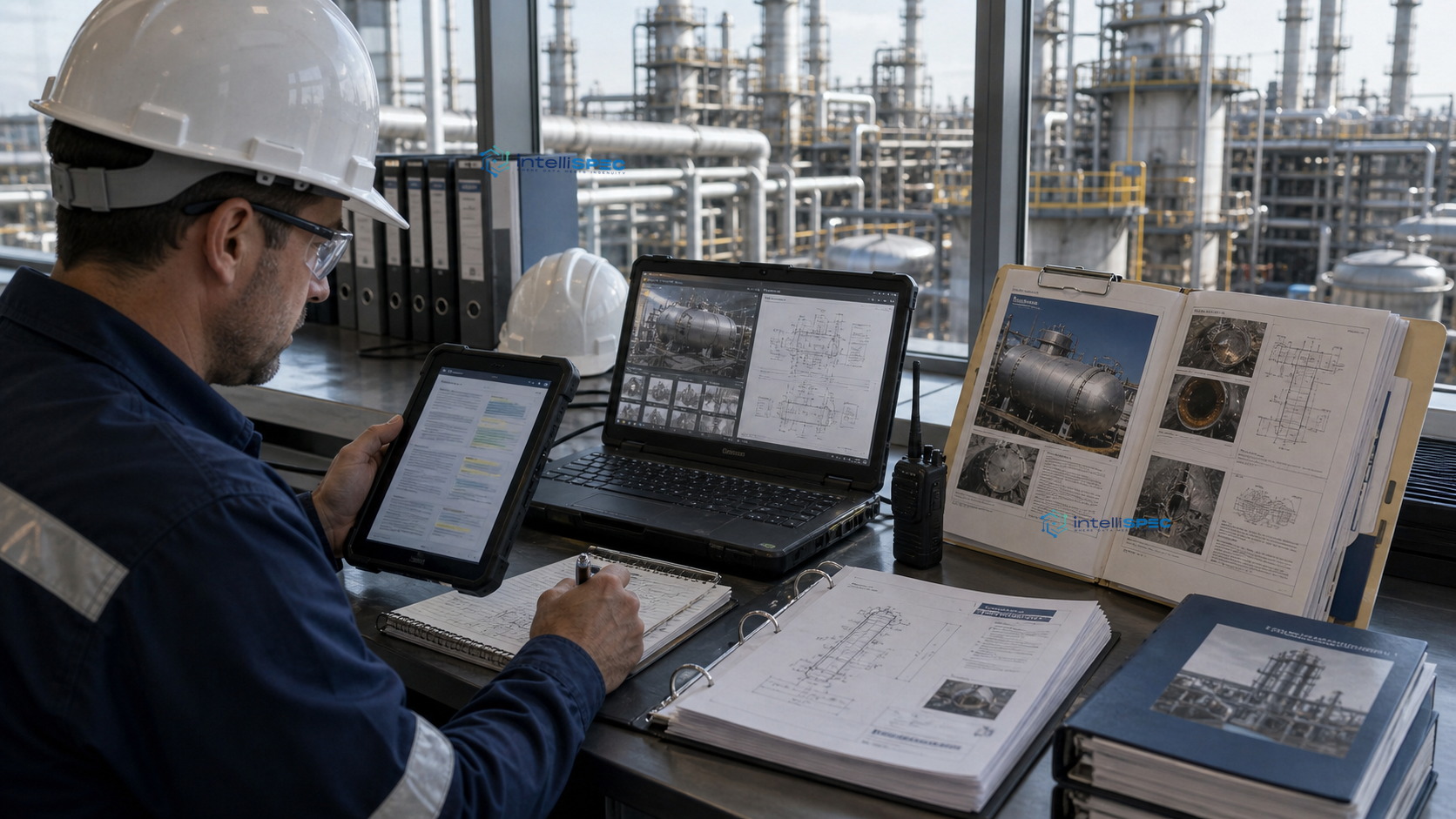
The case for digital inspection forms is usually sold as "faster than paper," and that is the weakest version of it. A clipboard is fast. An experienced inspector with a paper form and a pencil is genuinely quick, and any tablet workflow that loses to the clipboard on capture speed will be abandoned by week two, correctly. The real gains are elsewhere, and they compound for years after the shift ends.
Validation at the moment it can still matter
Paper accepts anything: a thickness reading with a dropped decimal, a skipped section, a checkbox left ambiguous, a reading that is thicker than the nominal wall. Every one of those becomes visible only at review, days later, when the scaffold is down and the vessel is closed. The defining property of a digital form is that it can push the review to the moment of capture:
- Range checks flag a reading outside the plausible band while the technician is still standing at the CML and can re-measure in ten seconds.
- Required fields make an incomplete record impossible to submit, rather than possible to discover.
- Conditional logic shows the follow-up questions a finding demands, so the form itself carries the procedure's decision tree instead of relying on recall.
Re-work is the hidden cost center of inspection programs, and validation at capture is the only mechanism that actually reduces it. Everything else just detects it sooner.
Structure, or why your history is currently unreadable
A completed paper form is a picture of data, not data. Ask a simple program question, every reading below t-min across the unit this year, every open coating deficiency older than ninety days, and paper archives answer with a person, a table, and a week of transcription. The same question against structured records is a query.
This is the gain that surprises teams most, because it is invisible at capture time. Trend analysis, corrosion rates computed from the full history rather than the last two points, KPI reporting, and audit sampling all fall out of the fact that a digital form stores fields, not pages. Ten years of paper is a storage problem. Ten years of structured records is an asset.
One record, never forked
Paper forks. The field copy gets transcribed into a spreadsheet, summarized into a report, and now three versions of the truth exist with no authoritative one. Auditors find the discrepancies even when nothing dishonest happened, because transcription always drifts. A digital record captured once is the same record the reviewer signs, the report renders, and the auditor reads. Attribution and time come along free: who entered what, when, is a property of the record rather than a handwriting question.
What paper still gets right
Honesty requires the other column. Paper never runs out of battery, never needs provisioning, and imposes zero learning curve. A digital form that requires connectivity in a tank interior, or fights gloved hands, or buries the technician in taps, is worse than the clipboard it replaced. The gains above are architectural, and they only materialize if the field experience clears the clipboard bar: offline by default, fast to the first field, forgiving of the environment.
That bar is the design brief intelliSPEC's field forms were built to, validation and structure at capture, offline, so the record assembles as the work happens instead of forking afterward. Bring your most-used paper form to a demo and run it against the digital version.