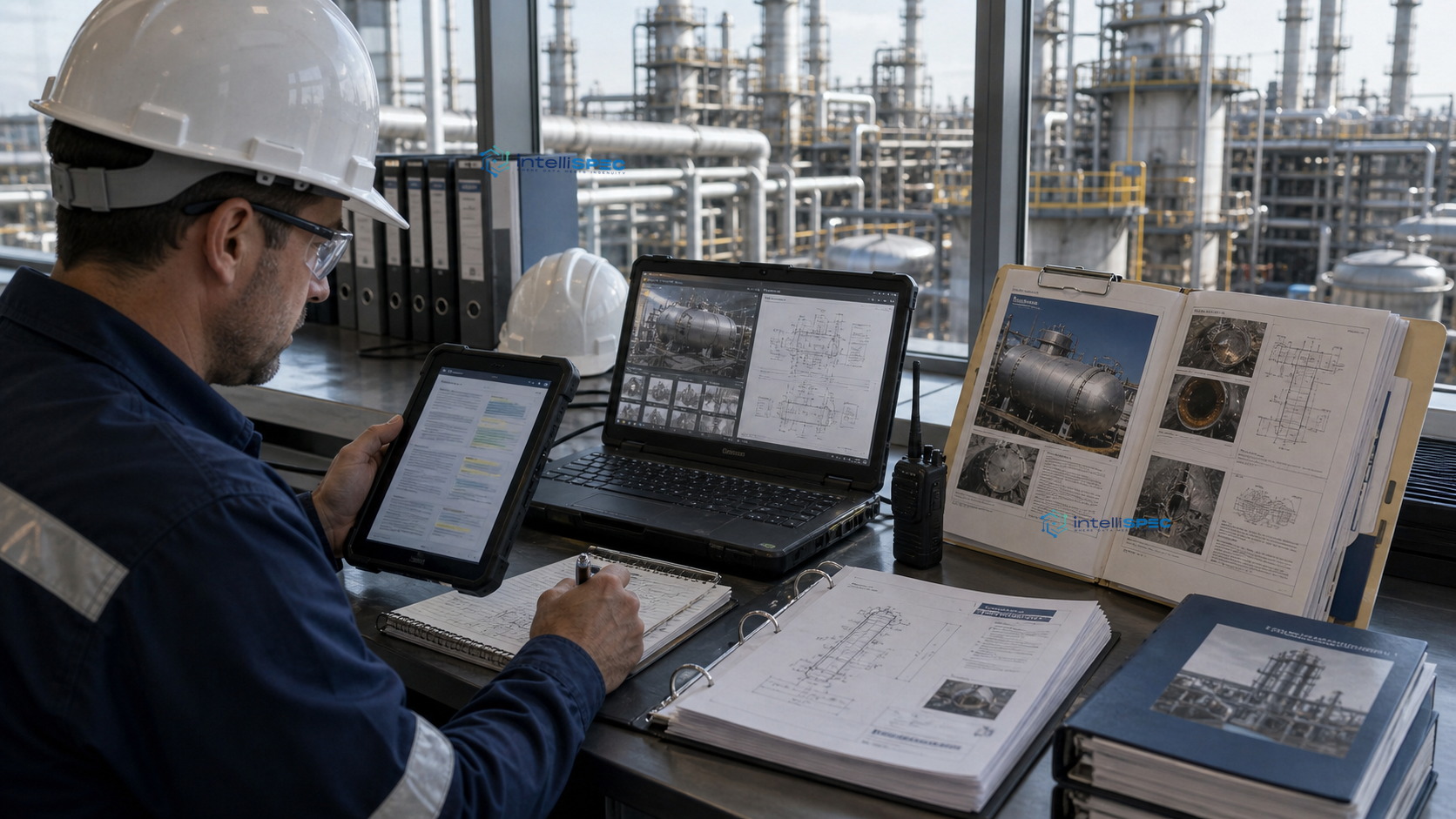
ASME PCC-2 is the repair catalog for pressure equipment in service: welded build-up and overlay, flush and flanged patches, full-encirclement sleeves, non-metallic composite wraps, mechanical clamps, and more. Each article describes a method, its applicability limits, its design approach, and its examination requirements. What the standard cannot do is keep the repair attached to the equipment's history. That is the owner's job, and it is where repairs most often turn from solutions into audit findings.
A repair is a design decision with a paper trail
Every PCC-2 method starts from the same questions: what is the damage, what mechanism caused it, what loads must the repaired component carry, and is this repair intended to be permanent or temporary? The answers determine which article even applies. A composite wrap over external thinning is a different engineering problem from a wrap over an active internal mechanism, and a method chosen without the damage mechanism on record is a method chosen blind.
The file for any repair should therefore begin before the work: the finding that prompted it, the mechanism attribution, the method selection with its applicability check, and the design calculation or justification for the repair itself. For welded methods that means procedure qualification and welder qualification. For engineered composite systems it means the qualified material system, the installer qualification, and the design basis for thickness and layers.
Examination is part of the repair, not a follow-up
Each repair article carries its own examination expectations: surface examination of weld build-up, volumetric examination where the method and geometry demand it, leak testing where warranted. The record must show the examination performed, the technique, the acceptance criteria applied, the result, and the examiner. A structurally sound repair with no examination record is, for compliance purposes, an unverified repair. Post-repair, the inspection plan has to absorb the change: new CMLs on and around a build-up, revised rates where geometry changed flow, monitoring of a wrap's edges for the mechanism continuing underneath it.
Temporary means dated
The most reliable failure in repair recordkeeping is the temporary repair that quietly becomes permanent. Clamps and leak enclosures, some patch configurations, and many wrap applications are installed with a defined service window and a stated plan: replace, re-repair permanently, or retire at the next opportunity. The window and the plan are conditions, and conditions need owners and dates.
The pattern that auditors find instead: a clamp installed during a run under time pressure, documented in a work order, mentioned in a shift log, and absent from the inspection file. Three years and one turnaround later the clamp is still there, its design life exceeded, its existence unknown to the integrity plan. Nobody decided to keep it. The record simply never carried it forward, so no decision was ever forced.
A defensible temporary repair record carries: the installation date, the engineering life or expiry, the follow-up action and its target window, the monitoring requirement in the meantime, and each subsequent review that either executed the plan or consciously extended it with justification.
The single-thread test
The test for repair records is the same as for inspection records: from the equipment file alone, an outsider should find every repair on the item, live or historical, and for each one walk from the originating finding through method selection, execution records, examination results, and current status. Repairs discovered by walking the unit rather than reading the file are the finding.
intelliSPEC attaches repairs, examinations, and expiry conditions to the same equipment record the inspection plan reads, so temporary never silently becomes permanent. Bring your clamp list to a demo and see it tracked.